
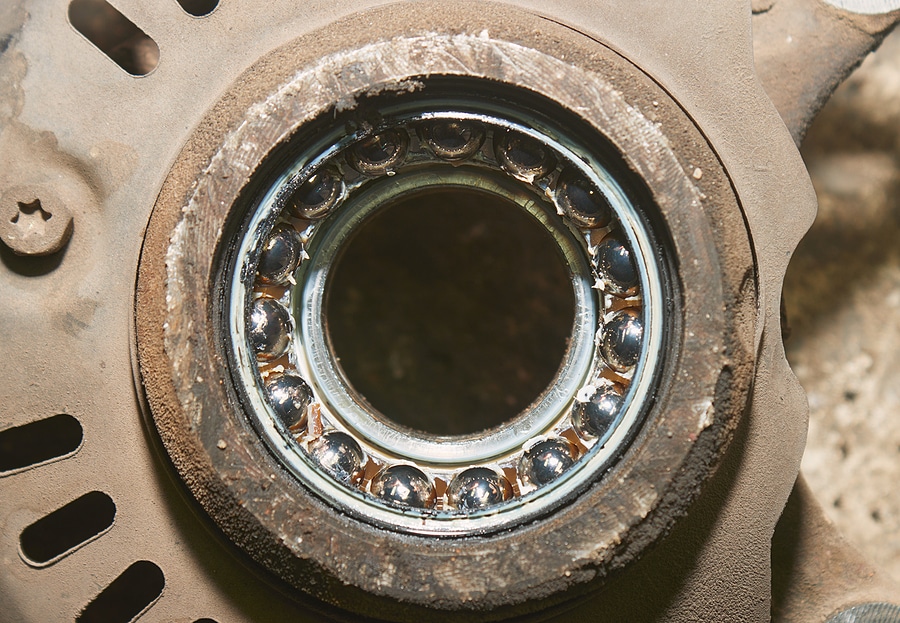
If you are hearing a strange, unusual noise coming from your car while you’re driving, it’s possible you may be experiencing wheel bearing malfunction. Wheel bearings are safety-critical components that are designed to sustain axial and radial loads caused by breaking, accelerating, and cornering. A crucial part of your vehicle’s good functioning, problems with wheel bearings need to be addressed quickly to prevent further damage.
What Are Wheel Bearings?
Wheel bearings are sets of steel balls or tapers held together by a metal ring. They enable the wheels to rotate smoothly with minimal friction. At the center of a vehicle’s wheels are hollow pieces of metal called hubs. Wheel bearings fit tightly within the hubs and ride on metal axle shafts, which helps to reduce friction when wheels spin.
Wheel bearings are different from engine bearings in that there is no constant source of lubrication. This means that wheel bearings need to be tight in order to keep away debris, water, and dust. Additionally, they support the entire vehicle’s weight while it is operation, which is the reason they are subject to a lot of wear and tear.
What Causes Wheel Bearing Malfunction?
There are a number of reasons wheel bearings might fail. The following are some common causes for wheel bearing failure.
Driving Conditions
Frequently driving through mud, water, or road salt can cause wheel bearing malfunction. Contaminants can get past the seals and enter the bearings, which pollutes the grease and damages the bearings.
Quality
As with any car part, the quality of the wheel bearing makes a big difference in terms of how long it will last. Bearings are precision products, and therefore need complex manufacturing processes. Low-quality steel often has poor heat-treating that can spall and wear prematurely and contain hard or soft metal that leads to failure. It is important to consult with a trusted auto mechanic to ensure your car is outfitting with strong, durable wheel bearings.
Uneven Roads
The more frequently you drive on uneven terrains, the more likely it is that your wheel bearings will become damaged and worn. Over time, the steel balls will develop damaged areas that will limit their ability to reduce friction for wheels. At that point, taking your car to an auto repair shop is necessary.
Poor Installation
The simplest errors, such as using the wrong tools, can cause damage to the exterior or interior of the wheel end bearing. This causes the wheel bearing to fail prematurely. Reusing older accessories, such as nuts, bolts, splint pins, and seals, can also cause wheel end bearings to operate unsafely, which increases the risk of an accident.
Imbalanced tires
It is critical for any good car maintenance routine to make sure your vehicle’s tires are balanced. Otherwise, some wheel bearings will endure more pressure and stress than others, leading to damage. Take your car in to a car garage and have a car mechanic take a look if you suspect your tires are imbalanced.
Accidents
An automobile accident can cause damage to any part of a vehicle, including wheel bearings. An impact that even slightly dents them can cause malfunction. Potholes, speed bumps, and even hitting curbs can cause damage to wheel bearings that can be diagnosed by an auto mechanic.
How Do Wheel Bearings Affect Car Performance?
Wheel bearings are a critical part of vehicle performance. They are important to the healthy function of any vehicle in that they help the wheel rotate smoothly. Additionally, wheel bearings are necessary for decreased friction caused by various other parts of the drivetrain system. When they become damaged or need to be replaced, serious problems can occur that can ultimately be very costly. Further, when wheel bearings are not replaced by a trained auto mechanic using the proper tools, damage can become even more severe.
Wheel bearings have an average lifespan of 85,000 to 100,000 miles. If you notice unusual noises, such as humming, growling, or rumbling noises that increase with acceleration, it is important to have your car examined by an auto repair technician as soon as possible. You might start to hear a howling sound during acceleration and deceleration, which can signal problems with gears and differential pinion bearing preload. Accompanied by a rumbling sound, this could mean the bearings are failing to support the gears sufficiently.
Looseness, vague steering or steering wheel vibration and ABS system malfunctioning can also be signs of problems with your wheel bearings. Driving with worn wheel bearings can cause serious damage to your drive-axle and steering assembly. It ultimately can be a major safety hazard. Driving on a bad wheel bearing puts stress on the hub and CV joint, brake system components, and ultimately on the transmission itself. Replacing wheel bearings is somewhat complicated, so it requires professional assistance.
Common Brand Issues
- Jeep – Some types of Jeeps often experience issues with wheel bearings. Operators will notice strange rumbling noises coming from the wheels. This is usually a sign of worn out wheel bearings. This noise will be most noticeable when the vehicle is operating at speeds over 30 mph and when turning corners at low speeds. Replacing faulty or worn out wheel bearings will usually fix the problem.
- Subaru – Subarus also often encounter issues with wheel bearings. On some models, the bearings bolt in, either replacing the entire unit hub or transferring over to the hub. Subaru has extended the warranty on rear wheel bearings to 100k on certain vehicles. It is important that you know to what kind of issues your make and model might be susceptible. If you are not sure if your Subaru is prone to wheel bearing malfunction, ask your local mechanic.
Frequently Asked Questions
Is it safe to drive with a bad wheel bearing?
It depends on the severity of the damage, but driving with a failing wheel bearing is never recommended. As the bearing continues to wear, it can create excessive wheel play, affect steering and braking performance, damage the wheel hub or axle, and in severe cases, lead to wheel separation. If you hear a persistent humming, grinding, or growling noise, have your vehicle inspected as soon as possible.
How can I tell if the noise is a wheel bearing or a tire?
Both worn tires and failing wheel bearings can create humming or roaring noises. However, wheel bearing noise often changes when turning. For example, if the noise becomes louder when turning left and quieter when turning right (or vice versa), it may indicate a failing bearing on the opposite side. A technician can confirm the source through a road test and physical inspection.
Can a bad wheel bearing cause uneven tire wear?
Yes. Excessive play in a worn wheel bearing can allow the wheel to move slightly out of its intended position, contributing to irregular tire wear. Because uneven tire wear can also result from poor alignment, suspension problems, or improper tire inflation, a professional inspection is the best way to identify the underlying cause.
Will a bad wheel bearing affect wheel alignment?
While a worn wheel bearing doesn’t directly change your vehicle’s alignment settings, excessive bearing wear can create wheel movement that mimics alignment problems. You may notice pulling, wandering, or unstable steering. If a wheel bearing is replaced, your mechanic may also recommend checking the alignment to ensure proper tire wear and handling.
Can a bad wheel bearing cause ABS or traction control warning lights?
Yes. Many modern vehicles have wheel speed sensors integrated into or located near the wheel bearing hub assembly. If the bearing develops excessive play or the sensor is damaged, it can interfere with wheel speed readings and trigger the ABS, traction control, or stability control warning lights.
Are wheel bearings replaced individually or in pairs?
Unlike some suspension components, wheel bearings are usually replaced only if they are worn or damaged. However, if both bearings on the same axle show similar wear or have comparable mileage, your mechanic may recommend replacing them together to reduce future labor costs and maintain consistent performance.
What happens if a wheel bearing completely fails?
A severely failed wheel bearing can allow excessive wheel movement, damage the hub assembly, affect braking performance, and place additional stress on the CV axle, suspension, and steering components. In extreme cases, the wheel can seize or separate from the vehicle, creating a serious safety hazard. Early diagnosis helps prevent more extensive and expensive repairs.
How are bad wheel bearings diagnosed?
A technician will typically perform a road test to identify the noise, inspect the wheel for excessive movement by checking for play at different positions, spin the wheel to listen for roughness, and inspect the hub assembly and related suspension components. In some cases, electronic diagnostic equipment may also be used if warning lights are present.
Contact Us for Quality Towson Car Repair Services
If you are in need of wheel bearing replacement in Baltimore, Maryland or the surrounding areas, call Hollenshade’s. You can also call today at 410-983-6265 or fill out our quick form and someone will reach out to you within 24 hours. We offer a wide range of comprehensive auto mechanic services as well as ongoing vehicle maintenance and repair.